Z41.1 ICD-10 Code for Cosmetic Surgery: Cosmetic vs Medical Coding
Z41.1 is the ICD-10-CM code for an encounter for cosmetic surgery or procedure. When to use it, what it excludes, and how medical coding differs.
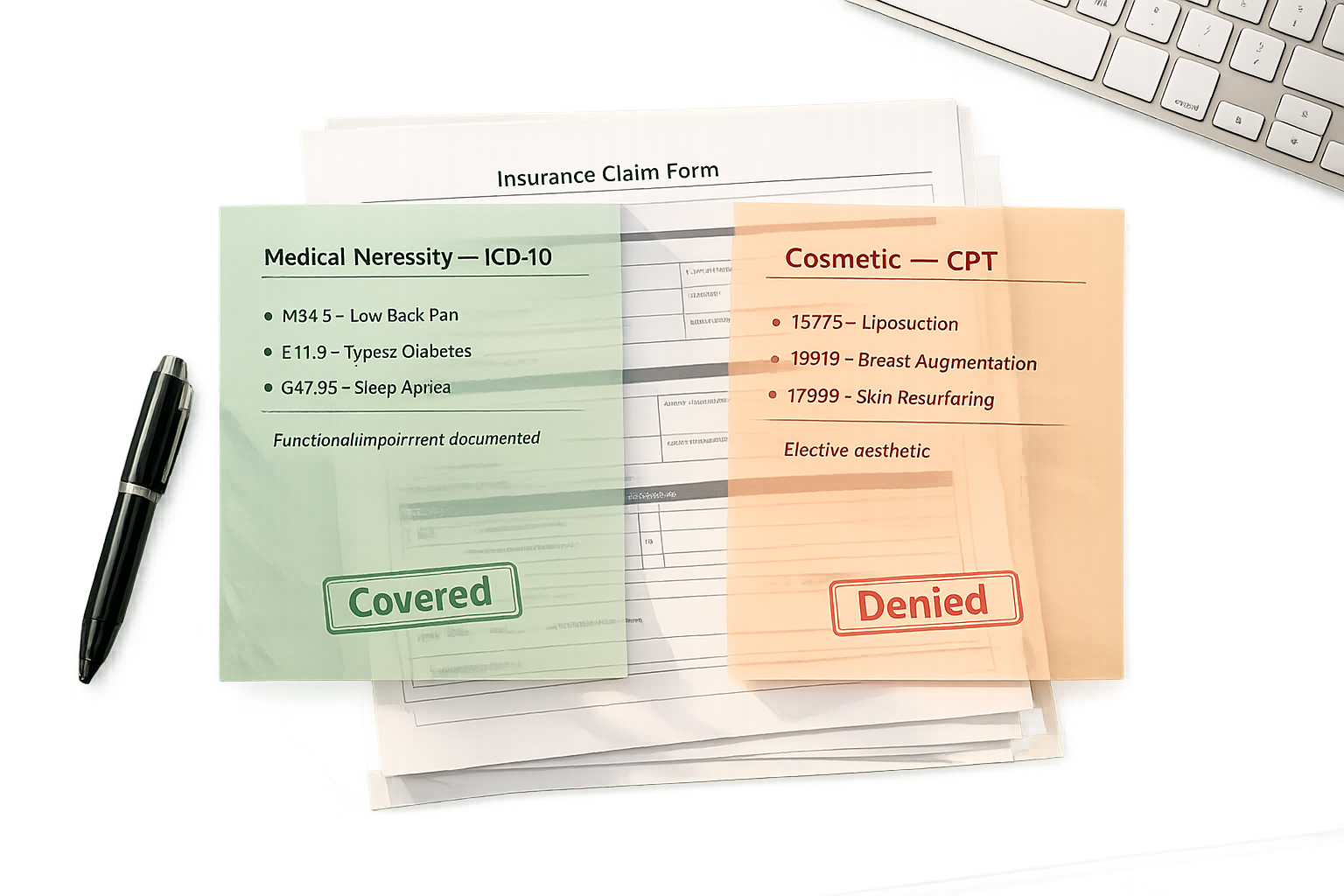

Z41.1 is the ICD-10-CM code for an encounter for cosmetic surgery, including cosmetic procedures and cosmetic breast implants; it cannot be reported with Z42.- (plastic and reconstructive surgery following medical procedure or healed injury). Use it when a service is done only to change appearance. When the record documents a functional problem, the diagnosis is that problem, not Z41.1.
- Z41.1: encounter for cosmetic surgery. Inclusion terms: encounter for cosmetic breast implant; encounter for cosmetic procedure. Excludes1: Z42.- and post-mastectomy breast implantation (Z42.1).
- Z42.-: encounter for plastic and reconstructive surgery following a medical procedure or healed injury (for example, Z42.1, breast reconstruction following mastectomy). The official guidelines list Z42 as a code that may only be reported first-listed.
- Z41.8 / Z41.9: other or unspecified procedures for purposes other than remedying health state.
- GY modifier (Medicare): item or service statutorily excluded, or does not meet the definition of any Medicare benefit.
- GX modifier (Medicare): a voluntary Advance Beneficiary Notice (ABN) was issued for a statutorily excluded service.
The same CPT code can describe cosmetic or medical work. The diagnosis and the clinical record decide which it is, and whether any plan pays.
Sources checked October 14, 2026 · Prepared by Prospyr. No certified-coder or clinician review is claimed. CPT is a registered trademark of the American Medical Association; use the current licensed code set. ICD-10-CM codes change every October 1; confirm codes against the code set in effect on the date of service.
How Medicare defines cosmetic surgery
The Medicare Benefit Policy Manual (Chapter 16, §120) says cosmetic surgery, and expenses incurred in connection with it, are not covered. It defines cosmetic surgery as "any surgical procedure directed at improving appearance, except when required for the prompt (i.e., as soon as medically feasible) repair of accidental injury or for the improvement of the functioning of a malformed body member." It also says the exclusion does not apply to surgery for therapeutic purposes that coincidentally serves a cosmetic purpose.
The statutory exclusion is Section 1862(a)(10) of the Social Security Act. Separately, Section 1862(a)(1)(A) limits Medicare payment to services that are reasonable and necessary. Noridian's Medicare article on cosmetic versus reconstructive surgery puts the distinction plainly: cosmetic surgery reshapes normal structures to improve appearance; reconstructive surgery restores function or corrects a deformity resulting from disease, injury, birth defects or previous treatment.
Commercial plans publish their own cosmetic and reconstructive policies. Read the patient's actual plan policy; do not assume Medicare's rules carry over.
The same procedure can be cosmetic or medical
Many CPT codes do not say why the work was done. Some common examples:
| Procedure | CPT code (descriptor summary) | What moves it from cosmetic to medical |
|---|---|---|
| Upper-eyelid blepharoplasty | 15822 (upper eyelid); 15823 (upper eyelid, with excessive skin weighting down lid) | Documented visual-field obstruction from dermatochalasis (H02.831 right upper eyelid, H02.834 left upper eyelid), per the payer's policy |
| Rhinoplasty | 30420 (rhinoplasty, primary; including major septal repair) | Documented nasal airway obstruction, for example from a deviated septum (J34.2) |
| Nasal valve repair | 30465 (repair of nasal vestibular stenosis, for example spreader grafting) | Documented nasal valve or vestibular stenosis with obstruction |
| Panniculectomy | 15830 (excision of excess skin and subcutaneous tissue, abdomen, infraumbilical panniculectomy) | Documented complications of the pannus that meet the payer's criteria |
| Abdominoplasty components | +15847 (add-on to 15830: abdominoplasty, including umbilical transposition and fascial plication) | Payers commonly treat this as cosmetic; check the plan policy |
| Breast reduction | Procedure code per the operative note | Hypertrophy of breast (N62) and the payer's documentation criteria |
For hospital outpatient departments, Medicare requires prior authorization for blepharoplasty, botulinum toxin injections, panniculectomy, rhinoplasty and vein ablation (since July 1, 2020), because these services are sometimes cosmetic. That program covers hospital outpatient departments; check your own setting and contractor.
Lesion removal is another overlap. Benign excision codes (11400-11446) and malignant excision codes (11600-11646) are selected by excised diameter: CPT instructs coders to use the lesion's diameter plus the most narrow margins required. Malignant excision codes depend on the pathology result. Removing a benign lesion for appearance alone is cosmetic.
Reading about the problem? See how Prospyr solves it in one platform.
Book a DemoCoding a cosmetic service
- Record the reason for the visit in the patient's own words and the clinician's findings. "Wants a smoother nasal profile" and "cannot breathe through the left nostril" lead to different coding.
- When the service is done only for appearance, the diagnosis is Z41.1 and the service is normally self-pay.
- Never attach a medical diagnosis to an appearance-only service to get it paid. A code must describe the care actually documented.
- If a Medicare patient asks you to submit a claim for a cosmetic service so they receive a denial, the claim describes the cosmetic service truthfully; GY signals a statutory exclusion.
Do cosmetic services need an ABN?
Usually not. For Original Medicare, an ABN is required when Medicare normally covers a service but you expect it to deny this one (for example, as not reasonable and necessary). Cosmetic surgery is a statutory exclusion, so an ABN is not required; CMS allows a voluntary one, reported with GX. Medicare Advantage and commercial plans have their own notice processes. Whatever the payer, explain the expected charge to the patient in writing before treatment. See the ABN answer for cosmetic services.
Coding a medically necessary procedure
A valid CPT code and a valid diagnosis are not enough on their own. The record should show:
- The chief complaint and how long it has lasted
- Objective findings (for example, visual-field testing, photographs, measurements)
- The functional problem the procedure is meant to fix
- Conservative treatment tried, for how long and why it failed, where the payer requires it
- The link between the diagnosis and the procedure
Read the payer's policy before surgery. Many plans require prior authorization, and authorization is not a guarantee of payment.
Cases with both cosmetic and medical work
When one operation includes a covered portion and a cosmetic portion, the operative note should separate the two, and the cosmetic portion is the patient's responsibility. Agree the cosmetic charge in writing before the procedure.
Modifiers have narrow meanings. Modifier 59 marks a distinct procedural service (for example, a different site or separate lesion) and is not a way to bypass an edit. Modifier 22 marks substantially greater work than usual and needs documentation of why. Modifier 25 marks a significant, separately identifiable E/M service on the same day as a procedure; see the modifier 25 answer.
Keep the review simple
Before any claim, a coder or billing lead should confirm that the diagnosis, the procedure and the note agree, and that the service is not appearance-only. Spot-check charts for cosmetic services that were sent to insurance by mistake.
Prospyr supports charting, digital intake, inventory and practice operations for aesthetic practices. It does not submit insurance claims; practices that bill insurance heavily need a separate claims solution.
Sources
- ICD-10-CM Z41.1, Encounter for cosmetic surgery (AAPC)
- CDC ICD-10-CM browser tool
- ICD-10-CM Official Guidelines for Coding and Reporting FY 2025 (CMS)
- Medicare Benefit Policy Manual, Chapter 16, §120 Cosmetic Surgery (CMS)
- Social Security Act §1862 (SSA)
- Cosmetic vs Reconstructive Surgery (Noridian JF)
- Medicare coverage: cosmetic surgery (Medicare.gov)
- Prior authorization for certain hospital outpatient department services (CMS)
- HCPCS modifier GY (Palmetto GBA)
- Advance Beneficiary Notice of Noncoverage (CMS)
- Panniculectomy, excision of excess skin and related services (First Coast, Medicare)
Free PDF guide + worksheets
Claims readiness workbook
Get the public answers and fillable review worksheets in one PDF. Save your own copy or print it for a team review. Use internal references only; keep patient information in your authorized clinical system.
- ✓ Sourced answers and practical examples
- ✓ Worksheets for your team to complete
- ✓ Official references and review prompts